
Choosing the right concrete grade is one of the most important decisions in any construction project. Get it wrong, and you risk structural weakness, budget overruns, or unnecessary over-engineering. Get it right, and your foundation, slab, or structure performs exactly as it should for decades.
If you’ve been researching concrete for your home, commercial building, or infrastructure project, you’ve probably come across grades like M20, M25, and M30. But what do these numbers actually mean, and how do you know which one your project needs?
As a trusted supplier of readymix concrete in Chennai, we get asked this question almost every day. This guide breaks it down in plain language, with a local lens because Chennai’s soil, climate, and construction norms all play a role in this decision.
Why Concrete Grade Selection Matters
Not all concrete is created equal, and using the wrong grade can cost you far more than money. Under-grading a structural element can lead to cracks, reduced lifespan, or even safety hazards. Over-grading, on the other hand, means paying for strength you’ll never actually use money that could go toward better finishing, steel reinforcement, or other project essentials.
This is why concrete grade isn’t a “one-size-fits-all” decision. It depends on what you’re building, where you’re building it, and what loads and environmental conditions the structure will face — especially in a city like Chennai, where coastal humidity and monsoon rains add extra stress on materials over time.
What does “M20,” “M25,” and “M30” Actually Mean?
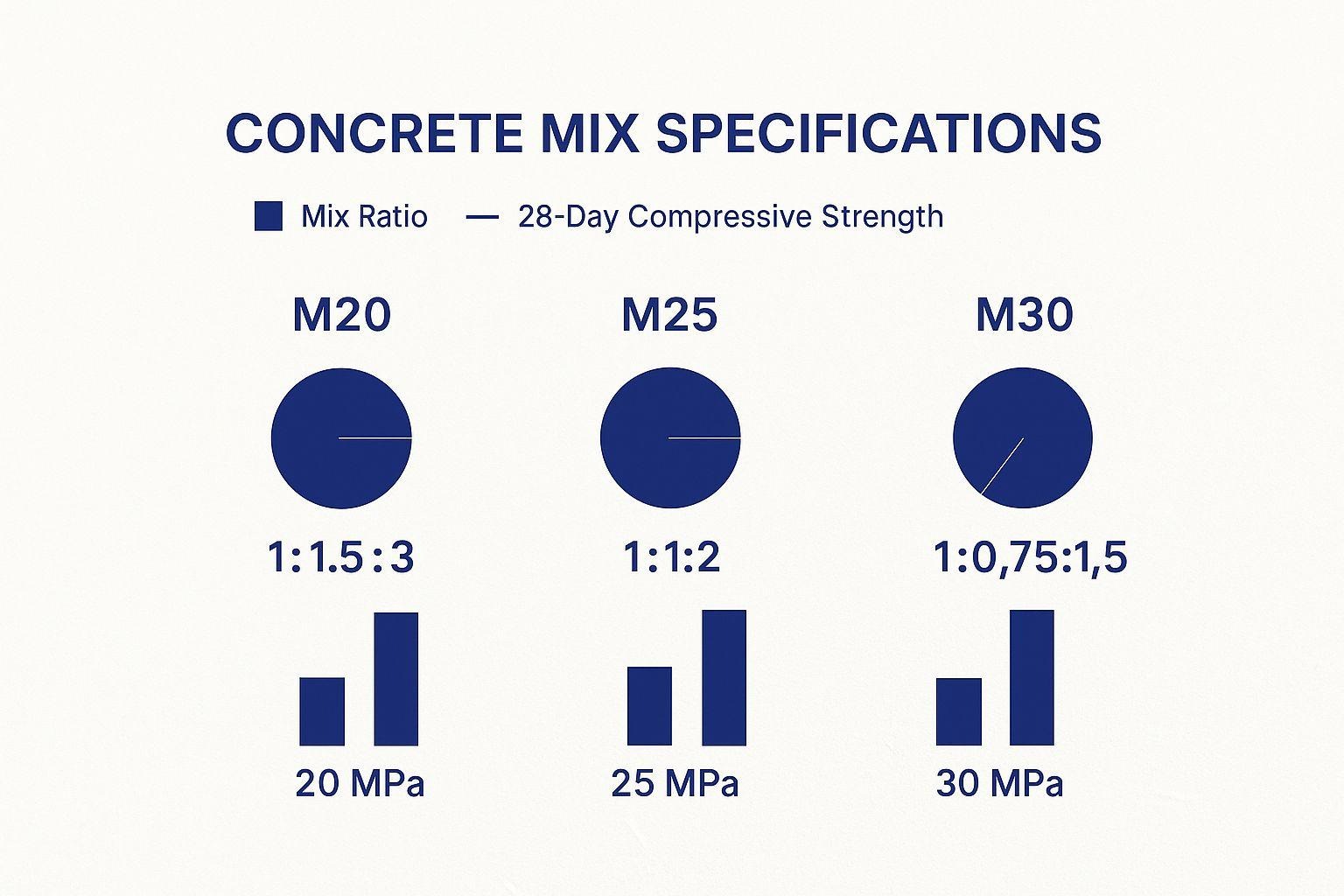
The “M” stands for Mix, and the number that follows represents the characteristic compressive strength of the concrete in Megapascals (MPa) after 28 days of curing.
- M20 = 20 MPa (N/mm²) compressive strength
- M25 = 25 MPa (N/mm²) compressive strength
- M30 = 30 MPa (N/mm²) compressive strength
In simple terms: the higher the number, the stronger and more load-bearing the concrete is. But strength isn’t the only factor – cost, application, and durability requirements all come into play too.
M20 Concrete: The Everyday Workhorse
Mix Ratio (nominal): 1 : 1.5 : 3 (cement : sand : aggregate) Compressive Strength: 20 MPa
Best used for:
- Residential slabs and flooring
- Boundary walls and compound walls
- Footpaths and pavements
- Low-rise residential buildings (G+1, G+2)
- Non-structural elements
Why it’s popular in Chennai: M20 is the most commonly used grade for standard residential construction across Tamil Nadu. It offers a solid balance between cost and performance for everyday builds where loads aren’t extreme – think independent houses, small apartment blocks, and general civil works.
M25 Concrete: The Mid-Range Performer
Mix Ratio (nominal): 1 : 1 : 2 (cement : sand : aggregate) Compressive Strength: 25 MPa
Best used for:
- RCC (Reinforced Cement Concrete) structures
- Multi-storey residential buildings
- Columns, beams, and structural slabs
- Water-retaining structures (with proper additives)
- Commercial buildings with moderate load requirements
Why it matters in Chennai: With the city’s construction landscape shifting toward G+3 and G+4 apartment complexes, M25 has become the go-to grade for developers who need more strength than M20 offers but don’t require the heavy-duty specifications of M30. Sourcing M25 as readymix concrete in Chennai ensures consistent quality batch after batch especially important for areas with higher groundwater tables or moisture exposure, common in several parts of the city.
M30 Concrete: Built for Heavy-Duty Applications
Mix Ratio: Design mix (not nominal requires lab-tested proportions) Compressive Strength: 30 MPa
Best used for:
- High-rise buildings and commercial towers
- Bridges, flyovers, and metro infrastructure
- Industrial structures and heavy machinery foundations
- Structures exposed to aggressive environments (coastal salinity, chemical exposure)
- Water tanks, retaining walls, and structures needing higher durability
Why it’s relevant for Chennai projects: As a coastal city, Chennai’s structures especially those near OMR, ECR, and other coastal stretches face higher exposure to salinity and humidity, which can accelerate corrosion of reinforcement steel. M30 and higher grades are often specified for such zones because they offer better durability, lower permeability, and longer service life. For this grade especially, readymix concrete in Chennai is strongly recommended over site-mixing, since precise batching is critical to achieving consistent design-mix strength. M30 is also mandatory for many RCC structural elements as per IS 456:2000 guidelines when using higher exposure conditions.
M20 vs M25 vs M30 Comparison Table
Not sure which grade fits your project? Here’s a side-by-side look at M20, M25, and M30 covering strength, cost, durability, and where each one is typically used in Chennai.
| Feature | M20 | M25 | M30 |
| Compressive Strength | 20 MPa | 25 MPa | 30 MPa |
| Mix Type | Nominal | Nominal / Design | Design Mix |
| Typical Use | Residential, non-structural | RCC structures, mid-rise buildings | High-rise, infrastructure, coastal zones |
| Cost | Lowest | Moderate | Higher |
| Durability | Standard | Good | Excellent |
| Common in Chennai for | Independent houses | Apartments (G+3/G+4) | High-rises, metro, coastal builds |
How to Choose the Right Grade for Your Project

Here’s what we recommend considering before finalizing a grade:
1. Structural Load Requirements Get a structural engineer’s input. The number of floors, expected load, and building type will largely dictate the minimum grade required this isn’t a decision to make on cost alone.
2. Exposure Conditions Chennai’s coastal humidity and monsoon-driven moisture exposure mean that projects near the coast or in low-lying, water-logged areas often need higher grades (M25 or M30) for better durability, even if the structural load doesn’t strictly demand it.
3. Local Building Codes and IS Standards As per IS 456:2000, minimum grades are specified based on exposure conditions mild, moderate, severe, and so on. A concrete manufacturing company in Chennai familiar with local IS code applications can guide you on compliance, not just strength numbers.
4. Budget vs. Long-Term Value M20 is cheaper upfront, but if your structure needs more durability, going lower to save costs can mean expensive repairs later. M25 or M30 often pays for itself over the structure’s lifespan.
5. Readymix vs. Site-Mixed For M25 and M30 especially, readymix concrete in Chennai from a certified batching plant ensures consistent quality, proper curing conditions, and IS-compliant mix design something that’s much harder to guarantee with site mixing.
Why Choose Readymix Concrete in Chennai Over Site-Mixed Concrete
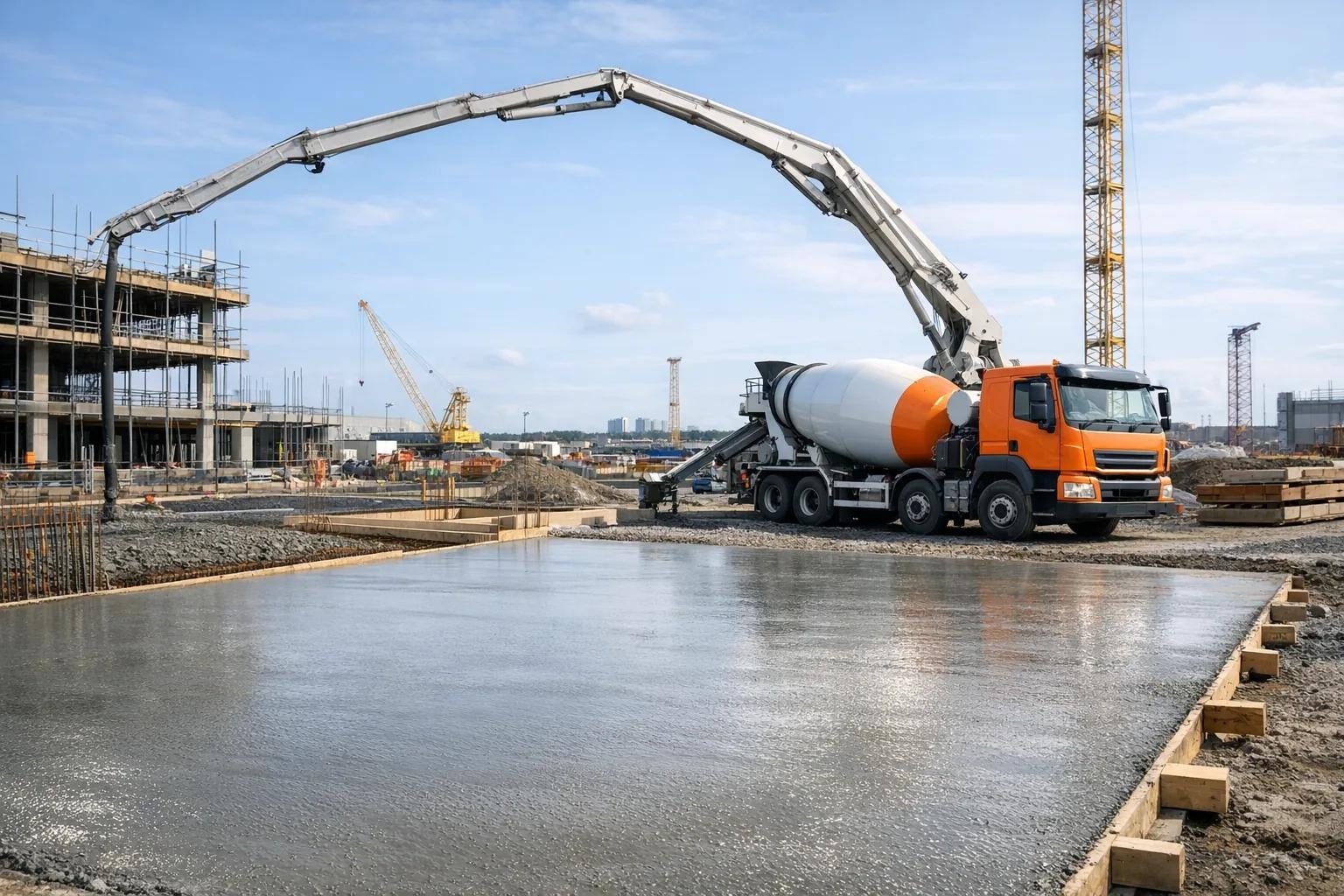
Concrete performance isn’t just about the mix ratio on paper it’s about how that mix behaves in Chennai’s specific climate, humidity, and soil conditions. Opting for readymix concrete in Chennai from a certified supplier brings:
- Region-specific mix design tailored to Chennai’s coastal and monsoon conditions
- Consistent quality control through batching plants and lab-tested mixes
- Faster delivery and logistics for time-sensitive pours
- IS code compliance and technical guidance for your specific project type
- Cost-effective bulk supply for large-scale or repeat projects
Whether you’re building an independent home, a residential complex, or a commercial structure, choosing the right grade and the right supplier makes all the difference in how your structure performs over the next 30, 50, or even 100 years.
Concrete Manufacturing Company in Chennai
Behind every reliable batch of readymix concrete is a well-equipped concrete manufacturing company in Chennai that understands local conditions, IS code requirements, and the demands of modern construction. From residential builders to large infrastructure contractors, choosing a manufacturer with the right expertise matters just as much as choosing the right grade.
Here’s what to look for in a concrete manufacturing company in Chennai:
- Certified batching plants with automated mixing for consistent quality
- In-house quality testing labs to verify strength, workability, and durability
- Experience with coastal and monsoon-specific mix designs
- Timely delivery fleet to ensure concrete reaches site within workable time limits
- Technical support for grade selection, mix design, and IS code compliance
Working with an established concrete manufacturing company in Chennai means you’re not just buying concrete you’re getting engineering expertise, quality assurance, and reliability built into every delivery.
Frequently asked questions:
1. Which concrete grade is best for a residential building in Chennai?
For independent houses and low-rise residential buildings (G+1, G+2), M20 is generally sufficient. However, for multi-storey apartments (G+3 and above) or homes near coastal areas with higher moisture exposure, M25 is often recommended for better strength and durability.
2. Is readymix concrete better than site-mixed concrete?
Yes, in most cases. Readymix concrete in Chennai offers consistent quality through automated batching, proper mix proportions, and lab-tested strength something that’s difficult to achieve with manual site mixing. It also saves time and reduces material wastage.
3. Why does Chennai’s coastal climate affect concrete grade selection?
Chennai’s coastal humidity and salinity can accelerate corrosion of reinforcement steel over time. For structures near ECR, OMR, or other coastal zones, higher grades like M30 are often recommended for better durability and resistance to moisture-related damage.
Final Thoughts
M20, M25, and M30 each serve a distinct purpose. M20 works well for general residential use, M25 suits mid-rise RCC structures, and M30 is built for heavy-duty, high-durability applications especially relevant in Chennai’s coastal and high-moisture zones.
The best approach? Don’t guess. Talk to a structural engineer, understand your exposure conditions, and partner with a reliable supplier of readymix concrete in Chennai that can guide you through mix selection, quality assurance, and timely delivery.
Need help selecting the Right concrete grade for your next project? Get in touch with our technical team for a free consultation and site-specific recommendations.